When I started this blog at the beginning of the primaries, I was hoping that I could comment on this year’s election cycle on a regular basis. And I did a pretty good job up to April. By April, I had to start dedicating my energies to other projects.
I did follow the elections very closely, but I could not find the time to write my reactions to the race’s many twists and turns.
I plan today to write a few blog posts. This one is on the presidential race. The next one will look at some of the counties that I will be following as the results of the election start coming in.
Who will the presidential election?
In 2012, we had a competition among the political science faculty at Drew University to see who could accurately predict the outcome of the presidential election. I won the competition, which was a bit surprising. I got all the states right minus North Carolina, which Mitt Romney won. While I was following Nate Silver’s model very closely, I was also a fan of Sam Wang’s Princeton Election Consortium’s (PEC) forecast.
This year I designed a similar competition but we invited our students and Drew alumni to join the game. More than 85 people completed the survey. Will I be able to defend my 2012 title? We will know in a few hours….
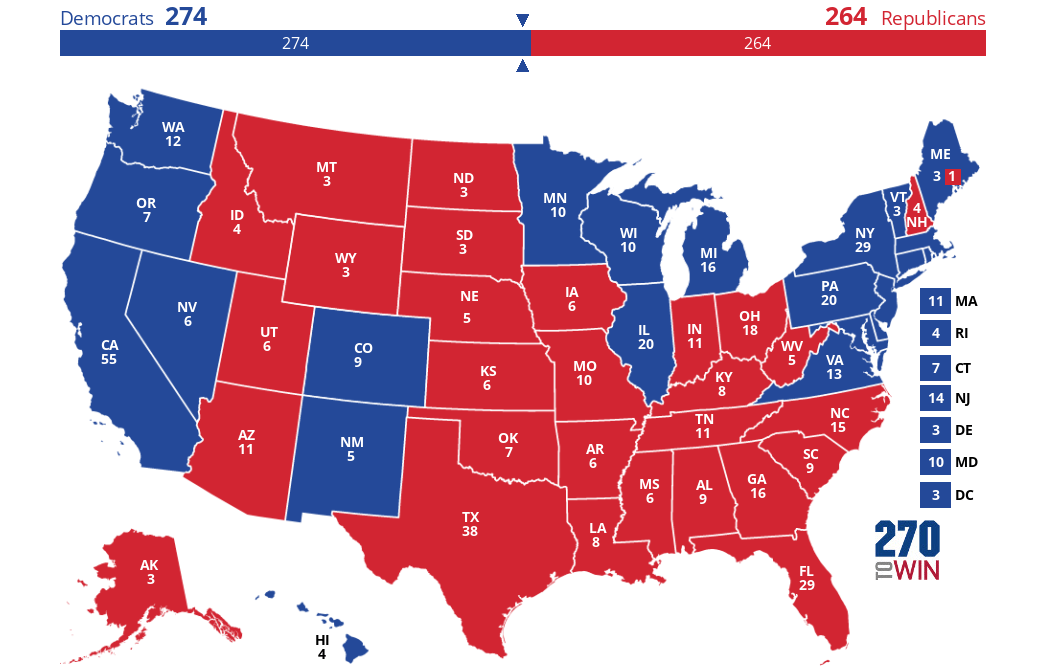
Here is the map I submitted yesterday night:
I have to admit I played a lot with the map before I made my final selections. I looked closely at PEC’s forecast, at FiveThirtyEight’s model – created by Nate Silver, and the Real Clear Politics’ poll of polling averages. I also read closely some polls from the battleground states.
There is a pretty good chance that Hillary Clinton will win more states. I think her ceiling is around 322, which is in line with Larry Sabato’s prediction. But, polling data (and my gut) says that it will be closer a race. Let me explain, the logic of my argument.
I believe that Donald Trump will win all the states Romney won in 2012, which includes North Carolina, and he will flip Ohio, Iowa, Florida and Maine’s 2nd Congressional District. Indeed, Trump cannot win the presidency without NC, FL, and OH. Let me explain why I think he will win these three states, though the polls show that Clinton seems to be gaining strength at the national level and many of the battleground states.
First, the Clinton campaign has been concerned by signs that the African American vote will not be as high as in 2012. It is important to note that turnout among African Americans remained the same – around 13% of the electorate – in 2008 and 2012. But African Americans slightly favored Romney over McCain.
The early vote data in NC does show that the African American vote has declined by at least 8%. In contrast, there has been an increase of White voters and independent voters, which have largely favored Trump. This could change with same day voting but the initial numbers are not very encouraging for Democrats.
In FL, the African American vote has not declined, but polls show that Trump’s numbers may be better than Romney’s performance. Romney received only 4% of the African American vote, while Obama received 95% – according to exit polls. According to the most recent CBS/YouGov poll, Trump will get 6% of the African American vote and Clinton will receive 91%. The declines in these figures for Democrats are not that big, but in a tight race these margins matter.
We will see how things shape in OH, but the polls have mostly favored Trump and OH is less diverse when compared to NC and FL.
Second, I am not sure whether Millennials will vote at 2012 levels. Millennials now represent the biggest voting group in the US after Baby Boomers. It is also the most diverse cohort. While these voters tend to vote Democratic, the question is whether they will show up. In 2012, this cohort represented 19% of the electorate. Romney won 37% of the Millennial vote. National polls show that Trump will get around 25% of this vote. This should be good news for Clinton. But, while Obama earned 60% of the Millennial vote in 2012, Clinton is currently polling around 55%. The rest of Millennials are expected to support third party candidates.
In FL, Obama won 68% of the Millennial vote, while Romney won 32%. The CBS/YouGov poll of FL suggests that the Millennial vote will be split along the following lines: 44% for Clinton, 28% for Trump, 14% for Gary Johnson and 6% for Jill Stein. If these numbers are accurate, then it will be a long night for Clinton.
Third, while I am glad to see a surge among Latino/a voters, I am not sure if this will affect Trump as much as we think. Let’s look at FL again because it has a large Latino/a population. In 2012, Hispanics favored Obama over Romney 60% to 39%. The most recent CBS/YouGov finds that Clinton will get 54% of the vote, while Trump will receive 34%. Surprisingly, 3% will vote for Stein and 1% for Johnson. These figures suggest that Clinton will underperform Obama’s numbers by 6%, while Trump’s numbers will be 5% points lower.
Hispanic voters are quite diverse and it is important to not generalize that vote. Cubans, Puerto Ricans, Mexicans, Central Americans, and South Americans have different voting preferences. Thus, I think it is important not to assume that because Latinos/as in Nevada are strongly voting against Trump, that the same will happen in FL, NC or other states.
These three observations explain why I think that Trump may win FL and NC. But how about IA, NH, and Maine’s 2nd Congressional District?
I think that these observations apply but these states are less diverse. On OH and IA, Trump has been leading most state polls. In the last week, polls in NH and in Maine’s 2nd Congressional District have tightened. In the end, I think that his populist message and his views on free trade resonate with many voters.
I was tempted to give Trump Michigan. And I think that Trump could flip this state. In the last week, the polls in Michigan show that Republicans are starting to move Trump’s way. If we assume that the African American vote will not be as strong this year, then this could help Trump win the state.
The same logic applies to Pennsylvania. If blue collars workers vote for Trump in big numbers and the Democrats have difficulty turning out the African American vote and the urban vote in Philadelphia, Trump could really make this an interesting race.
To conclude, Clinton wins but I think it will by a tight margin.
 Click the map to create your own at


